


Whether you are far from achieving your business goals – or it’s time for a new level of success – you need a high-performing team to achieve your goals now and into the future.
In this article, we’ll talk about how to build high-performing teams for your own organization. As you will see, an all-star team needs far more than just the right resources to “do the job.”
High-performance teams need an ecosystem of support, trust, and synergy to ensure strategic success. We will also discuss what characteristics your team will need and what models you can adapt to your own people.
Table of contents
- What Is a High-Performing Team?
- Key Characteristics of High-Performing Teams
- Developing a High-Performing Team Model for Your Organization
- 5 Things High-Performing Teams Do Differently
- The Benefits of High-Performance Teams
- Navigating Challenges Faced by High-Performance Teams
- Measuring and Evaluating High-Performance Teams
What Is a High-Performing Team?
A high-performing team is a group of individuals with complementary, synergistic skills who work together to achieve a common goal. More importantly, they meet or exceed desired objectives in an efficient and effective way.
Such goals could be maximizing business revenue, expanding into new markets, rebranding, reducing inefficiencies, and more.
High-performing team examples include: the elite Navy Seals, the Kansas City Chiefs in their multi-year Super Bowl Championships, and revolutionary businesses like Netflix and Amazon.
When your business brings together great people, they collaborate seamlessly and leverage each other’s strengths and expertise. High-performing teams also stay accountable and maintain a clear understanding of their roles and responsibilities.
Key Characteristics of High-Performing Teams
High-performing teams do so much more than meet desired metrics. Overall, they share a common vision, take ownership of their work, and tackle challenges together.
Some additional key characteristics of high-performing teams include:
- Clear Goals and Shared Vision: There is no question about what the team is working towards and how success will be measured.
- Effective Leadership: Leaders set the tone for the entire project journey. They guide, support, motivate, and ensure everyone stays the course.
- Communication and Collaboration: High-functioning teams maintain clear, direct, and respectful communication to ensure all team members are on the same page.
- Resilience and Adaptability: High-performing teams effectively resolve challenges (both expected and unexpected). They can also pivot their strategy, turning to creativity and innovation.
- Trust and Respect: Teams perform best when trust and respect are baked into every interaction. This helps reduce employee turnover, poor performance, and dissatisfaction.
- Diversity and Inclusion: The most effective teams draw from diverse experiences, ideas, and insights.
These characteristics are essential for teams to surpass expectations and navigate challenges. When people feel valued, they take ownership of their work and are motivated to achieve common goals, regardless of the level of difficulty.
Developing a High-Performing Team Model for Your Organization
Building high-performing teams requires intentionality and a strategic approach. Luckily, there are several types of high-performing team models that you can follow, each starts with a solid organizational plan.
Types of High-Performance Team Models
- Functional Teams: Organized based on specific functions or departments. Each team focuses on a specific area of expertise and collaborates with other teams to achieve organizational goals.
- Cross-Functional Teams: Consist of people from different departments or disciplines who come together. They offer diverse perspectives and expertise, leading to more innovative and well-rounded solutions.
- Self-Directed Teams: Manage their work independently and have a high degree of autonomy. They are responsible for setting their own goals and making strategic decisions.
- Virtual Teams: Collaborate remotely and leverage virtual communication tools to work together. These are ideal for including people from all over the world and promoting work-life balance.
Roles in a High-Performance Team
While you may find variations in practice, here are some common roles in high-performing teams:
- Team Leader: Oversees all operations and sets the tone for expectations, communication, and relationship building. While good leadership skills are ideal for this position, leaders should prioritize resourcefulness over being an “expert” in everything.
- Facilitator: Manages high-performance team dynamics and ensures interactions are productive, positive, and respectful. Staying organized and knowing how to empower people are great skills for this position.
- Subject Matter Experts: Provide expert knowledge and insights to help the team solve problems and accomplish goals. They may play a consulting role or help with specialized tasks.
- Team Members: Work collaboratively in their respective roles, which could be solving problems, researching, or creating defined deliverables for the project. Clear communication and continuous skill building is highly beneficial.
How to Build a High-Performing Team
Let’s go over some strategies to help you build a team that consistently delivers exceptional results:
- Define Goals and Expectations: When possible, goals should be measurable and expectations should be clear. Every team member should understand their responsibilities and how their role contributes to the team’s overall success.
- Recruit the Right Individuals: Look for people who are not only technically competent but who also possess strong interpersonal skills and a growth mindset. Since trust, communication, and belonging are essential for high performance, your people need to work well together.
- Invest in Skill Building: Provide opportunities for team members to develop their skills and capabilities (for themselves and for the betterment of the operation). Training, workshops, and coaching can enhance teamwork, communication, and problem solving.
- Strengthen Trust and Respect: Instill a culture of trust and psychological safety, where team members feel comfortable expressing their opinions, taking risks, and learning from failures. Encourage honesty and open communication at all levels.
- Promote Positive Collaboration: Encourage cross-functional projects, team-building activities, and knowledge-sharing to create a sense of shared purpose. Lead by example with positivity and cooperation.
- Reward and/or Correct Performance: To motivate all team members, acknowledge exceptional performance and celebrate achievements. Provide constructive feedback when necessary to help everyone grow and develop.
As you can see, building high-performance teams is not just about formulating a strategy to accomplish a particular goal. It’s about empowering your people, motivating them, and ensuring they feel comfortable to flourish in their roles.
5 Things High-Performing Teams Do Differently
At first glance, many of the concepts we’ve talked about look like the basic building blocks of any team. But what really makes one team outperform another?
#1 – They Are Ambitious
When you think of revolutionary teams – such as the startup teams at Apple, Amazon, or Google – they weren’t just “out of the box” thinkers. They were ambitious.
High-performing teams set stretch goals. And they may have a high risk of failure, especially initial iterations. These teams strive for excellence and are unafraid to aim high, challenging themselves to achieve remarkable results.
#2 – They Know What They Don’t Know
High-performing teams maintain a growth mindset and a thirst for knowledge. If they don’t have the expertise that they need in-house, they develop their existing team members or call in additional resources.
It is the job of leaders to actively seek learning and development opportunities while team members focus on expanding their knowledge and working at full capacity.
#3 – They Empower Their People
Some businesses attempt to save money by having team members perform various roles. But the most effective high-performing teams allow their people to focus on what they do best.
That means your specialists focus on their specialties. That means your consultants consult, and you delegate tasks to the appropriate people.
#4 – They Are Unafraid to Fail
People working in high-performance teams understand that trial and error is part of the process, even if you have the most experienced people working for you.
After all, ambitious goals require teams to push boundaries and formulate new ideas.
What really makes these teams successful is that they account for failure from the beginning. They plan and allot extra time and resources for experimentation – remaining resilient even when they’ve exhausted their first round of ideas.
#5 – They Value All Team Members
Leaders of high-functioning teams understand that great ideas can come from anyone at any level of the organization.
Many leaders disregard insights from lower-level or entry-level team members. But effective leaders take all perspectives and ideas into account before formulating an action plan.
This tends to happen in large organizations where leadership is focused on organization-wide initiatives, but they fail to understand the challenges of the frontline workers. To remedy this, invest time in surveys and interviews from all departments and levels.
The Benefits of High-Performance Teams
Building high-performing teams within your organization provides several benefits, including:
- Increased productivity
- More innovation
- Enhanced problem solving
- More clarity and effectiveness
And, let’s highlight some impressive statistics surrounding connected teams:
| Better Decision Making Teams almost always make better decisions than individuals (National Bureau of Economic Research) More Profitability Highly connected teams boost profitability by 21% compared to less connected teams. (Gallup) Greater Employee Satisfaction, Engagement, and Retention Connected, collaborative teams have 59% less employee turnover, 41% less absenteeism, and 66% better wellness. (Gallup) | Highly connected teams boost profitability by 21% compared to less connected teams. (Gallup) | Greater Employee Satisfaction, Engagement, and Retention Connected, collaborative teams have 59% less employee turnover, 41% less absenteeism, and 66% better wellness. (Gallup) |
Navigating Challenges Faced by High-Performance Teams
High-performing teams rarely experience linear success. They may be held back by failure, operational setbacks, and more.
Let’s highlight some challenges that high-performing teams face – many of which have nothing to do with the real task at hand!
| Common Challenges | Strategies to Overcome Them |
| Interpersonal Conflict | Conflict resolution, respectful leadership, clear communication |
| Team Member Burnout | Reduction of workload, clear communication, prioritization, employee empowerment, work-life balance |
| Lack of Alignment | Review of project goals, clear communication, prioritization |
| Conflicting Priorities | Goal establishment, clear communication |
| Poor Adaptation and/or Resilience | Skill development, honest feedback, learning from failure, employee empowerment |
To combat common challenges and restructure their teams, many businesses utilize resources like Tuckman’s Stages of Group Development and/or Lencioni’s Five Dysfunctions of a Team.
Measuring and Evaluating High-Performance Teams
High-performing teams are not perfect 100% of the time. They are constantly improving, especially in the face of failure.
Performance metrics are often based on your specific goals. Efficiency, efficacy, and profitability are the most common. Taking a look at employee satisfaction, engagement, and retention is also beneficial.
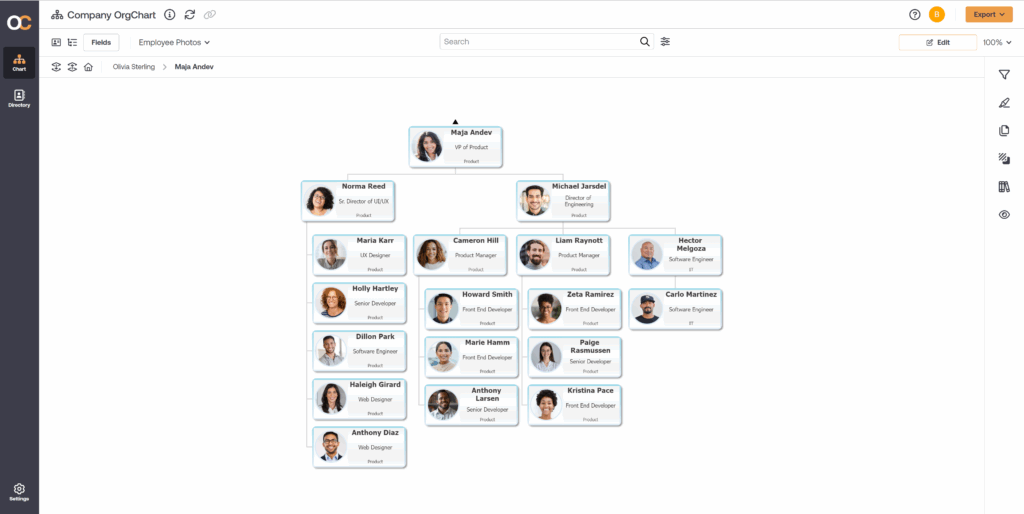
One of the most effective ways to monitor your high-performance team is to have a clear understanding of how the team is structured. Take advantage of adaptable tools like an organizational chart to help you.
Want to visualize the true potential of your team?
Book a Free OrgChart Demo
To learn more about other HR-related hot topics, explore more of our latest blogs, guides, and more here.
What Our Customers Say About OrgChart




Carolina F.
Small Business
Verified User in Pharmaceuticals
Mid-Market (51-1000 emp.)
Jacqueline W.
Mid-Market (51-1000 emp.)
Jillian P.
Head of Talent Acquisition & Onboarding Mid-Market (51-1000 emp.)
Leo C.
Managing Director Mid-Market (51-1000 emp.)