


As businesses evolve and grow, their organizational structures often need to adapt to accommodate new challenges and opportunities. Understanding various types of organizational structures is crucial for HR professionals seeking to optimize company operations and foster a productive work environment.
Let’s delve into several key types of organizational structures and “best-fit” scenarios. We will also discuss what to consider when designing (or redesigning) an organizational structure.
From there, you will be better equipped to choose the most suitable structure for your organization’s specific needs.
Table of contents
What Is Organizational Structure?
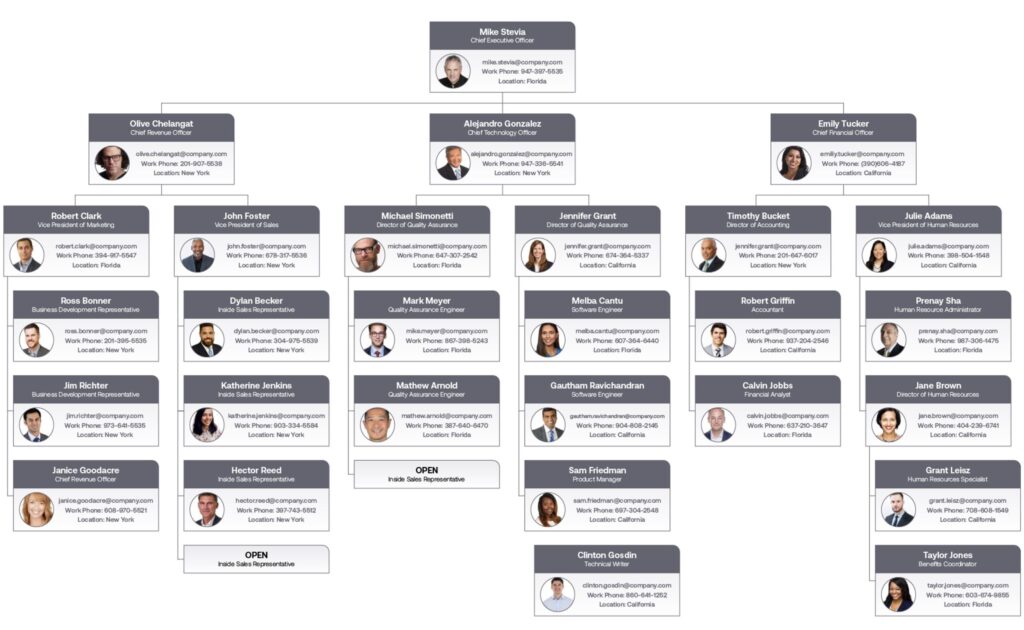
Organizational structure is the framework that defines how a company is organized and managed. It outlines the relationships between departments, teams, and individuals within the organization.
Organizational structure is essential for creating a clear chain of command, defining roles and responsibilities, and ensuring efficient communication and collaboration.
A well-designed organizational structure can significantly impact business success in various ways, including:
- Improving Efficiency: With clearly defined roles and responsibilities, organizations can minimize confusion, reduce duplication of efforts, and streamline processes.
- Enhancing Communication: Clear organizational structures facilitate effective collaboration between departments and individuals, leading to better decision-making and problem-solving.
- Promoting Accountability: With a defined chain of command, organizations can hold individuals accountable for their actions and performance.
- Facilitating Growth and Scalability: A flexible, adaptable structure can support company growth and expansion by enabling changes in organizational design.
3 Basic Types of Organizational Structures
Let’s define, compare, and contrast three basic types of organizational structures.
| Type of Org Structure | Description | Best Suited For | Pros | Cons |
| Functional | Divides a company by specialty or department (e.g. R&D, marketing, sales). | Companies of various sizes, especially those with highly focused product lines. | Clear chain of command; specialization; efficiency | Lack of flexibility and agility; siloed departments; lack of cross-collaboration |
| Divisional | Divides a company by market, product, service or geography. | Large companies and/or those with diverse product lines. Also great for companies in the process of expansion. | Specialized focus on individual products or markets; greater flexibility; more accountability | Potential for resource duplication; siloed departments |
| Matrix | A combination of functional and divisional structures, enabling dual reporting. | Organizations in need of cross-collaboration, flexibility, and/or project-based work. | Better collaboration; efficient resource allocation; flexibility and adaptability | Complexities regarding implementation and management; unclear reporting lines; potential for conflict |
These basic structures form the foundation of many organizations, but they can be combined with alternative organizational structures to meet a company’s unique needs.
Optimal organizational structure depends on factors such as company size, industry, culture, and strategic goals.
8 Alternative Types of Organizational Structures
Let’s define alternative organizational structures and compare and contrast them with pros, cons, and “best-suited for” scenarios.
Flat Organizational Structure
Flat org structures feature minimal hierarchy between top leadership and frontline employees. It is characterized by decentralized decision-making, which promotes autonomy and empowerment among employees.
| Pros Improved communication, faster decision-making, Increased employee satisfaction | Pros Improved communication, Faster decision-making, Increased employee satisfaction | Cons Potential for lack of clear direction, complexities in managing large teams |
Network Organizational Structure
Network org structures are characterized by a loosely connected network of independent teams or specialties, enabling flexibility, and adaptability. Collaboration is prioritized over maintaining a rigid hierarchy.
| Best Suited For Virtual organizations, Collaborations, Industries with rapid change | Pros Flexibility, Adaptability, Access to diverse expertise | Best Suited For Virtual organizations, collaborations, Industries with rapid change |
Team-Based Organizational Structure
Team-based org structures prioritize the optimal functioning of teams. Various teams and specialists can come together, and each is responsible for a specific function or project, fostering collaboration and innovation.
| Pros Increased employee engagement, Faster response times, improved problem-solving | Pros Increased employee engagement, Faster response timesImproved problem-solving | Cons Potential for overlapping responsibilities, complexities in maintaining alignment across teams |
Hierarchical Organizational Structure
Hierarchical org structures consist of a traditional pyramid-shape and a vertical chain of command. They have clear levels of authority, which provides stability and predictability.
| Best Suited For Large, established organizations, industries with high levels of regulation | Cons Prolonged decision-making, Limited employee autonomy, Bureaucracy | Best Suited For Large, established organizationsIndustries with high levels of regulation |
Line Organizational Structure
Line org structures are characterized by having direct lines of authority from top to bottom, emphasizing efficiency and accountability.
| Cons Limited flexibility, potential for bottlenecksDifficulty in scaling | Best Suited For Small, simple organizations, industries with limited need for specialization | Best Suited For Small, simple organizationsIndustries with limited need for specialization |
Project-Based Organizational Structure
Project-based org structures can sometimes be “temporary” structures that are created to complete specific projects or initiatives, providing flexibility and focus on specific goals.
| Pros Flexibility, focus on specific goals, and efficient resource allocation | Pros Flexibility, focus on specific goals, and Efficient resource allocation | Cons Potential duplication of efforts, Difficulty in maintaining consistency across projects |
Hybrid Organizational Structure
Hybrid org structures combine elements of different structures to address specific needs, offering increased flexibility and adaptability. For example: An organization may primarily operate under functional departments, but they create project-based teams when certain cross-functional projects come up.
| Pros Great flexibilityAdaptabilityAbility to tailor structure to specific challenges | Cons ComplexityPotential for confusionDifficulty in maintaining alignment | Best Suited For Organizations seeking to balance the advantages of various structures |
Circular Organizational Structure
Circular org structures prioritize equality and collaboration. Leaders are located in the center of the circle, with concentric rings of managers and lower-level employees radiating outward.
| Pros Improved communicationDiffused hierarchyIncreased employee empowerment | Cons Potential for lack of clear leadershipDifficulty in making decisions | Best Suited For Organizations seeking to foster a collaborative, egalitarian culture |
What Our Customers Say About OrgChart





Carolina F.
Small Business
Verified User in Pharmaceuticals
Mid-Market (51-1000 emp.)
Jacqueline W.
Mid-Market (51-1000 emp.)
Jillian P.
Head of Talent Acquisition & Onboarding Mid-Market (51-1000 emp.)
Leo C.
Managing Director Mid-Market (51-1000 emp.)
Key Elements of Organizational Structures
Organizational structures are composed of several interconnected elements that work together to define the reporting relationships, roles, and responsibilities within an organization.
| Key Elements | Description |
| Work Specialization | The degree to which tasks are divided into smaller, specialized jobs. Can increase efficiency but may also lead to job monotony. |
| Departmentation | The process of grouping jobs into departments based on similar activities, functions, products, customers, or geography. Helps to organize work and improve efficiency. |
| Chain of Command | The line of authority that extends from the top of the organization to the lowest levels. Defines reporting lines and establishes accountability. |
| Span of Control | The number of subordinates a manager can effectively supervise. A wide span of control can lead to increased efficiency, while a narrow span can result in more supervision and control. |
| Centralization/Decentralization | The degree to which decision-making authority is concentrated at the top of the organization (centralized) or distributed throughout the organization (decentralized). Centralization provides consistency and control. Decentralization empowers employees and improves responsiveness. |
| Formalization | The degree to which job duties are standardized and formalized through rules, procedures, and policies. High formalization can increase efficiency and consistency, but it can also limit flexibility and creativity. |
These elements interact and influence one another to shape the overall organizational structure.
For example: A company with highly specialized work and a narrow span of control might require centralized decision-making to ensure coordination and consistency. In contrast, a decentralized organization with a wide span of control may benefit from a flexible and adaptable approach to work specialization and departmentation.
How to Choose the Best Organizational Structure
To design a structure that supports your strategic goals, promotes efficiency and effectiveness, and fosters a positive work environment, here are some key factors to consider:
| Factor | Importance | Notes |
| Company Size and Complexity | Determines the level of hierarchy and specialization needed. | Large, complex organizations may require elaborate structures. Small organizations can often function with simple structures. |
| Industry and Market Conditions | Determines the need for agility, innovation, and responsiveness. | A competitive landscape can influence organizational structure. Rapidly changing industries may benefit from flexible, adaptable structures. |
| Company Culture and Values | Determines the need for decentralization, teamwork, or hierarchy. | Values can affect level of autonomy, collaboration, and employee empowerment. |
| Goals and Objectives | Determines which structure best supports the company’s mission and vision. | A company focused on growth and innovation may benefit from a decentralized structure. |
| Leadership Styles | Determines the necessary level of control and employee involvement. | An authoritarian leader may prefer a hierarchical structure. A participative leader may prefer a decentralized or team-based approach. |
| Technological Advancements | Determines the need for flexibility, remote work capabilities, and virtual collaboration. | Digital tools can enable more flexible and remote work arrangements. |
Organizational Chart Types Examples
Explore the following examples with visuals of how various industries design their unique organizational structures.
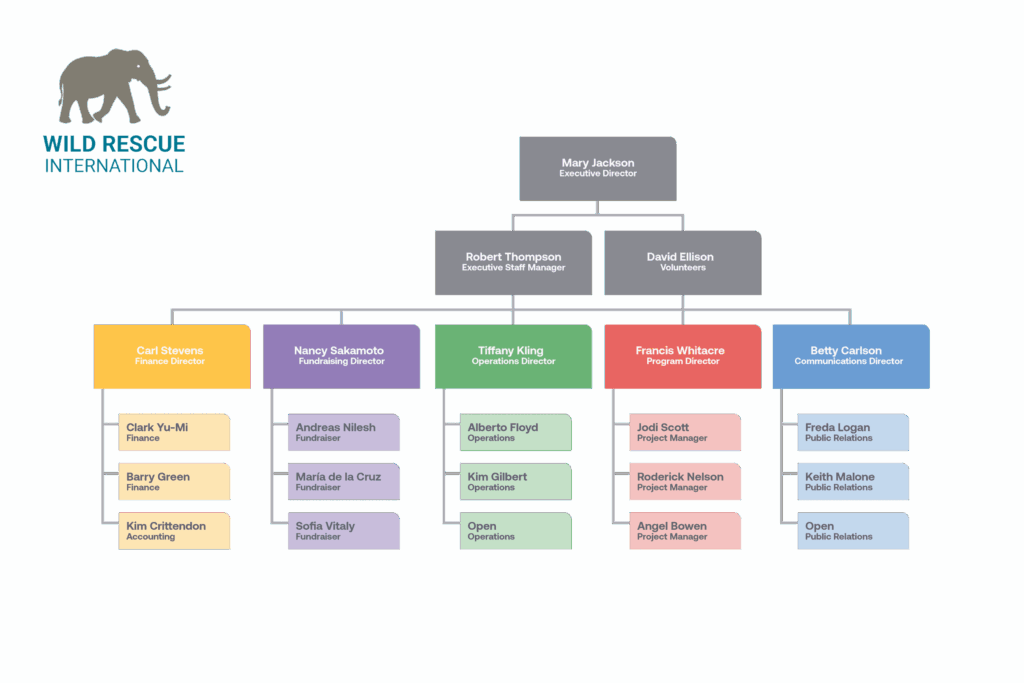
Non-Profit Org Chart Example
Non-profit organizations often have a board of directors at the top, followed by executive staff and program directors. The structure emphasizes accountability and transparency.
Learn more about non-profit organizational structures.
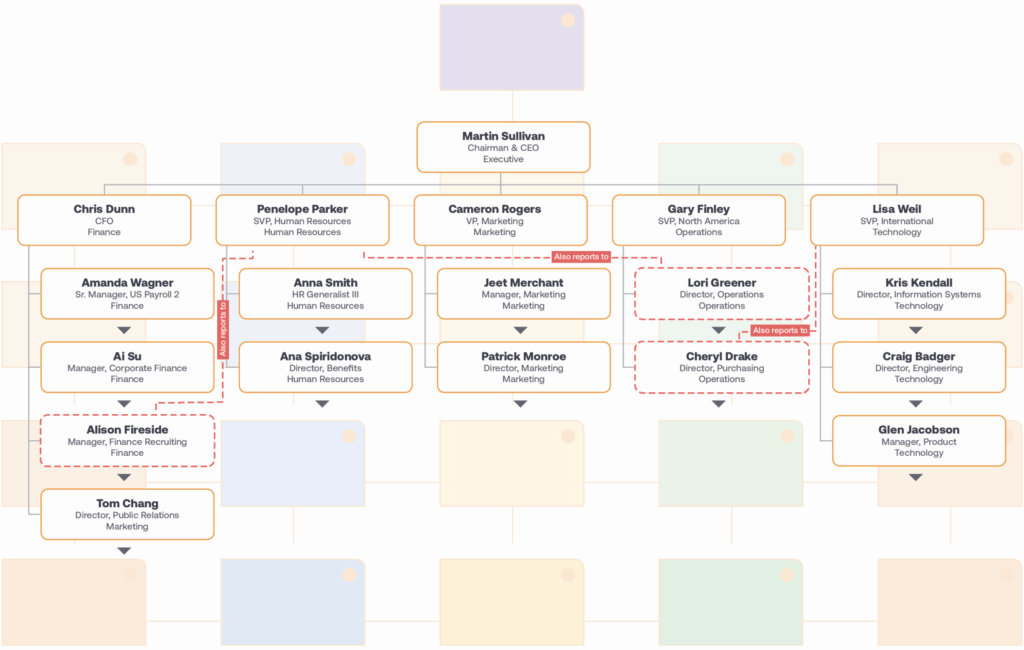
Matrix Org Chart Example
Matrix structures combine functional and divisional structures, leading to dual reporting lines. This can be beneficial for organizations that require flexibility and cross-functional collaboration.
Learn more about matrix organizational structures.
Functional Org Chart Example
Functional organizations are divided by departments based on similar activities (e.g. sales, marketing, finance). This is common for smaller, more stable companies.
Learn more about functional organizational structures.
Large Company Org Chart Example
Large companies often have complex structures with multiple layers of management and specialized departments. This allows for efficient division of labor and scalability.
Learn more about organizational charts for a large company.
Small Company Org Chart Example
Small companies may have simple structures, with fewer levels of management and more generalist roles. This can promote flexibility and agility.
Learn more about why every company, regardless of its size, needs a company org chart.
Construction Company Org Chart Example
Construction companies often have a project-based structure, with teams tasked to complete specific projects. This allows for efficient resource allocation and project management.
Learn more about construction company organizational structures.
Government Agency Org Chart Example
Government agencies typically have a hierarchical structure with clear lines of authority and accountability. This is necessary for ensuring compliance with regulations and policies.
Check out this white paper, Government Agency Organizational Chart Best Practices: The Complete Guide, for a deep dive into the organizational structure of government agencies.
Private Equity Org Chart Example
Private equity firms often have a centralized structure with a small team of partners at the top. This allows for tight control and decision-making.
Learn more about private equity organizational structures.
HR Department Org Chart Example
HR departments typically have a hierarchical structure with specialized roles such as recruitment, training, and compensation. This ensures efficient HR operations.
Learn more about HR department organizational structures.
Higher Education Org Chart Example
Universities often have a decentralized structure, with departments and colleges having significant autonomy. This allows for flexibility and innovation in academic programs.
Learn more about higher education organizational structures.
SAAS Company Org Chart Example
SAAS companies may have a flatter structure, with more emphasis on teams and collaboration. This can promote agility and innovation in the rapidly changing tech industry.
Learn more about SAAS company organizational structures.
Manufacturing Org Chart Example
Manufacturing companies often have a functional structure, with departments such as production, quality control, and logistics. This ensures efficient operations and product delivery.
Learn more about manufacturing company organizational structures.
Tools for Managing Organizational Structures
As your company grows, evolves, or undergoes strategic shifts, your organizational structure must adapt accordingly. This can be a complex task, especially for larger organizations with intricate reporting lines and departmental interactions.
Org chart software can be a helpful tool for creating, managing, and optimizing your organizational structure.
Solutions like OrgChart can help you:
- Visualize Your Structure: Build a clear and visually appealing representation of your organization. This is helpful for onboarding new employees, clarifying reporting lines, and identifying areas for improvement.
- Simplify Updates: Easily add, remove, or edit employee information to ensure your structure reflects the latest changes.
- Facilitate Collaboration: Enable real-time collaboration for improved transparency, and ensure the entire team is on the same page.
- Address Inefficiencies: Identify potential bottlenecks or redundancies. Some org chart software offer analytics to help you streamline or restructure.
- Plan and Predict: Use org chart software for strategic planning. Easily model potential changes to your structure and see how they might impact your organization before making decisions.
OrgChart is a leading provider of user-friendly, comprehensive org chart software. We offer a suite of features to streamline your organization management process, fully customize your charts, and align your structure with your goals.